Dari Brown, owner of I Need This, Antiques (Dealer Code: DBW) has been a dealer-merchant at the Queen of Hearts for 6 years, an appraiser for about 12 years, and has been in the “biz” buying and selling all over the United States for over 25 years. Dari has this to say about antiques, “They do not provide food or shelter that we may live. Why then do we "need this?" Because they make our lives worth living with the joy of the hunt, the successful acquisition, and most of all...the history, the beauty, and the energy these pieces bring from another time and place.” With two spaces on Church and Queen at the Buford Queen of Hearts, Dari says her most popular space is the Victorian booth located on Church St.
Customers and Queen staff have said "it is like walking into a Victorian parlor," and young people are especially fascinated by the authentic pieces that were the mainstay of life during the 19th century era. The Victorian booth carries almost 95% genuine antiques (items 100 years or older) and she finds these at various auctions, estate sales and thrift shops.
Her second space is located on Queen St and offers a general line of antiques, vintage items and upcycled furniture. This space offers a variety of antique transferware, American primitives, vintage prints and a display case packed with vintage jewelry, antique cut crystal, Civil War memorabilia, militaria, toys, and other interesting items.
Dari says that there are too many “favorites” about being a dealer-merchant at the Queen but shares that it is the excellent business model that provides a pro-active and attentive staff, lots of customers and the ability to sell a bit of history. Being an antiques dealer allows you to enrich ones life with beauty from another era. Additionally, the trend to upcycle or repurpose “found” items, especially antique furniture, that has seen rougher days, into renewed and unique purposes is exciting. It is so much fun to see utilitarian items transformed into lighting fixtures or coffee tables. Just about anything goes these days and the more interesting the greater demand for the item.
Dari started out as a collector, and in order to “feed the collecting habit” became a dealer. Dari collects antique clothing, laces and needlework, Native American basketry, rugs and pottery, Victorian jewelry, quadruple plate, American Brilliant cut crystal and Early American Pressed Glass (EAPG) compotes, to name a few. She also has three spinning wheels, two are genuine antiques, and adores spinning fiber from all three of them. It is a meditative process and brings her joy along with beautiful handspun to knit.
Dari was born and raised in New Jersey and then began traveling at the age of 12. She says she has gypsy feet and enjoys living in new locales. With 7 grandchildren scattered all over the U.S. and overseas, she has the opportunity to travel quite a bit. She presently works, full time, for a global communications company located in Lawrenceville, GA and (with 6 years left to go) is looking forward to when she can retire from corporate America permanently and meander through small communities in search of treasure, expand to another larger booth at the Queen, visit her grandchildren, and scuba dive the world’s seas in between the antique hunting.
Visit Dari's booth in the Queen of Hearts Buford on Church and Queen St., and visit her on Facebook at www.facebook.com/INeedThisAntiques to see all of her gorgeous finds. You can also read her blog, Musings of a Sea Witch.
Showing posts with label transferware. Show all posts
Sunday, January 25, 2015
Monday, August 8, 2011
What is Transferware?
It is a type of pottery and porcelain that uses a copper plate that has been engraved with a desired pattern. The color to be used was rubbed into the lines of the warmed plate, wiped of the excess and pressed onto a wet piece of specially made tissue paper. This tissue was then placed onto the vessel (plates, cups, saucers) and rubbed down by women called "Transferers." These women were expected to place the patterned tissue correctly, joining the seams of borders and designs and for applying the back stamp.
Transferware helped manufacturers produce very pretty pottery and porcelains quickly and less expensively than the previously hand painted pieces.
Next time you see a piece of Transferware, pick it up — look for the seams and notice how some line up perfectly and some are just a tad off. You might also notice the border running off the edge. Each piece is only as good as the Transferer — all hand applied one plate, cup or saucer at a time.
Usually each piece of Transferware tells a story. By looking at the back stamp, a collector can check the pattern name, the initials or name of the maker and sometimes the name of the town where the factory is located. Sometimes there are no back stamps and only the Stilt marks are showing — these are three little dots in the glaze that held the triangular spur pieces and separated the plates in the kiln.
Why does the color blue seem to be used so frequently in Transferware?
Blue comes from cobalt and was the only color at first that would survive the high temperature of the glaze process. The rich blue color is associated with famous historical plates and also in the early Flow Blue. Blue Willow is one of the most popular patterns of transferware. It was initally designed by the famous Thomas Minton around 1790.
Why does some of the blue transferware look blurred?
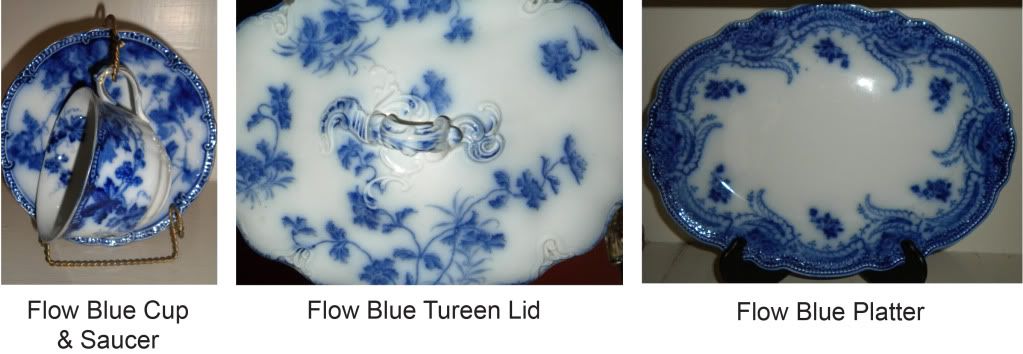
This blurred "look" is actually called Flow Blue. In 1545 in Saxony, a potter named Schurer used cobalt oxide and noticed that this blue soaked into the porous ware and blurred a bit in the glazing process. In 1820 it was discovered that the blue would "flow" by adding lime or chloride of ammonia to the sagger while glazing. The blurring covered printing faults and stiltmarks. When cobalt is initially applied it is brown and only turns blue in the firing process. Some think that Flow Blue china was a mistake and it eventually become a collectors item. This is not true — it was a deliberate process that is highly sought after by collectors.
Stay tuned for more posts on pottery, porcelains and the history of Blue Willow china.
Transferware helped manufacturers produce very pretty pottery and porcelains quickly and less expensively than the previously hand painted pieces.
Next time you see a piece of Transferware, pick it up — look for the seams and notice how some line up perfectly and some are just a tad off. You might also notice the border running off the edge. Each piece is only as good as the Transferer — all hand applied one plate, cup or saucer at a time.


What type of Transferware are you buying?
Usually each piece of Transferware tells a story. By looking at the back stamp, a collector can check the pattern name, the initials or name of the maker and sometimes the name of the town where the factory is located. Sometimes there are no back stamps and only the Stilt marks are showing — these are three little dots in the glaze that held the triangular spur pieces and separated the plates in the kiln.
Why does the color blue seem to be used so frequently in Transferware?
Blue comes from cobalt and was the only color at first that would survive the high temperature of the glaze process. The rich blue color is associated with famous historical plates and also in the early Flow Blue. Blue Willow is one of the most popular patterns of transferware. It was initally designed by the famous Thomas Minton around 1790.
Why does some of the blue transferware look blurred?

This blurred "look" is actually called Flow Blue. In 1545 in Saxony, a potter named Schurer used cobalt oxide and noticed that this blue soaked into the porous ware and blurred a bit in the glazing process. In 1820 it was discovered that the blue would "flow" by adding lime or chloride of ammonia to the sagger while glazing. The blurring covered printing faults and stiltmarks. When cobalt is initially applied it is brown and only turns blue in the firing process. Some think that Flow Blue china was a mistake and it eventually become a collectors item. This is not true — it was a deliberate process that is highly sought after by collectors.
Stay tuned for more posts on pottery, porcelains and the history of Blue Willow china.
Subscribe to:
Posts (Atom)